
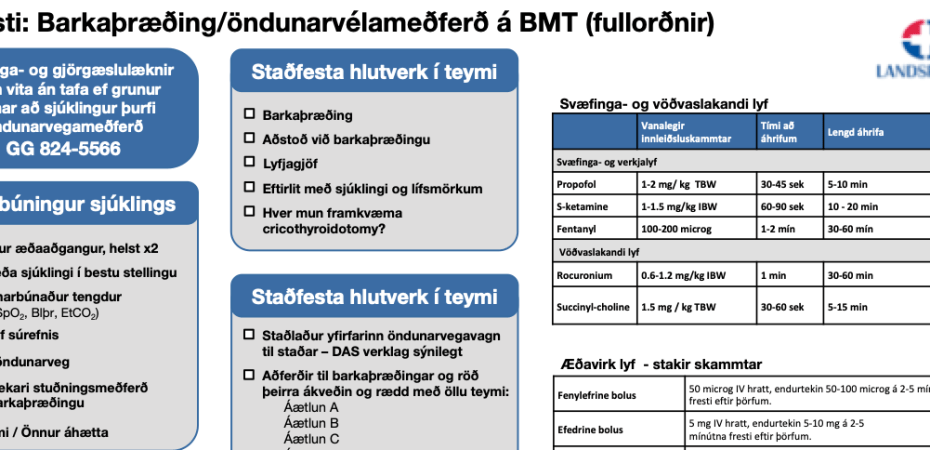
We have finally accepted our checklist for intubation in the ER at the Landspítali.
It is a great step forward for us and also for the safety of patients.
Intubating is always stressful and under pressure we tend to narrow our vision and this is where the checklist becomes useful. Making sure the crucial parts are not forgotten.
I have seen patients being paralyzed, then the person asks for an ET tube and nobody prepared it ; syringes to secure the cuff not being ready ; patients being intubated without a pulse oxymeter.
I have also seen once one person one knee on the ground for the intubation, instead of pushing on the button to elevate the bed.
And I have probably forgot many things myself, we are all guilty.
This is not meant to do finger pointing, but to mention that even really experienced people can forget things. We are all humans.
Sometimes just assuming someone else has prepared the medication or the piece of equipment is bad.
Assumptions rarely helps in medicine.
But now we have something to minimize it : checklists!
Checklists
Believer or not in checklists, I think they are a powerful tool to assist us during certain procedures. We have strong evidence showing they help to decrease mortality for surgeries and decrease risk blood stream infection for central lines.
Sometimes, having a good intention is not enough. Checklists are felt to lenghten the process of an acute intervention, people can find them cumbersome and in certain settings, interestingly, they can prolong ICU lenght of stay.
Evidence
Regarding endotracheal intubation, what is the evidence?
The biggest study we have is a recent meta-analysis for the use of checklist in endotracheal intubation. It included 11 studies, most with high-risk of heterogeneity and the majority were done in the ER.
The use of checklist did not reduce mortality (primary outcome) or decreased esophageal intubation, hypotension or peri-cardiac arrest.
But the use of a checklist was associated with decrease of hypoxic events.
Of interests, the only randomized-control study we have is this one.
Our checklist
Obviously our checklist is in icelandic and I would be more than happy to translate it for those interested in it. It has been a great journey creating it in collaboration with our ICU colleagues.
Optimization of the hemodynamics, positioning of the patient, preparation of the equipment, role assignment and verbalization of Plan A-B-C-D are all present. The last section is about the post-intubation management.
Our checklist is brief, compact and contains all the crucial steps regarding an intubation.
Conclusion
From my experience, we tend to forget things. Sometimes, crucial preparation is missing and this applies also for experienced practitioners.
From my experience, people usually “get away” with it. At the end, the procedure is successful and no major adverse events happens, or at least that we notice. But I think it is only because people get lucky and some preparation with a checklist could caught these things.
So, what kind of doctor you want to be?
A lucky one that gets away with it or someone who is well prepared with a checklist?
You choose.
 Frozen Doc