

After doing airway management simulation rounds with our ER consultants, one knowledge gap we identified was the ventilator. The mighty ventilator.
Not everyone is confident using it and we really need to close the knowledge gap. We have evidence that we can cause harm misusing the ventilator and just “bagging” a patient until he goes upstairs.It is not only tiring, but imprecise and leads to hypo- or hyperventilation.
We have to keep this SIMPLE
Here are two movies that I have made, specifically for us in the ER, at the Landspítali, the University Hospital of Iceland.
The second movie is about which buttons to push on our machine to actually reach those settings.
The credit goes to my Resuscitation Leadership Academy mentors (Drs Haney Mallemat and Scott Weingart) who taught me how to use well my vent.
Thanks guys!
Our Ventilator
Here is our beast :
Weinmann Medumat Transport
Perfect for Transport, Air services, Ambulance
Settings for infant, children and adults (lowest age?)
Settings
These are the rough settings we are aiming at. Nothing new or fancy, these settings are in line with a “Lung Protective Strategy” that complies with the ARDSNet protocol.
Tidal volume : 6-8cc/kg, Predicted body weight
Rate : 15-18 / min
P Plateau < 30 cm H20 (on our machine, it needs a bit of tweaking, it is ninja level, or us “Viking” level)
FiO2 : 100% for 5 minutes then titrated according to Lower PEEP/FiO2 Chart
Get venous gaz 15 minutes after
Goals of treatment
- Saturation 88-95%
- pH: 7.30-7.45
ARDS Net chart
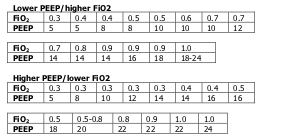
What then? Go watch, read or listen to all of this, now :
- First thing you need to do to reinforce and understand better is watching this movie https://emcrit.org/emcrit/vent-part-1/
- There are some situations where you can screw up. Those situations can be encountered with obstructive lungs (COPD, asthma), please watch this movie: https://emcrit.org/emcrit/vent-part-2/
- Managing Initial Mechanical Ventilation in the Emergency Department. The title says it all. https://emcrit.org/wp-content/uploads/2010/05/Managing-Initial-Vent-ED.pdf
- EM:RAP made an eye-candy, multiple parts and well explained videos about ventilator, SO GOOD : https://www.emrap.org/episode/icufundamentals1/ventilator
- ARDSNet Study
- LOV-ED Study : quasi-experimental that showed that implementation of a Lung protective strategy in an ER department decreased mortality in intubated patients
- Weinmann online simulator (online simulator provided by the company)
References :
Fuller, Brian M., Ian T. Ferguson, Nicholas M. Mohr, Anne M. Drewry, Christopher Palmer, Brian T. Wessman, Enyo Ablordeppey, et al. « Lung-Protective Ventilation Initiated in the Emergency Department (LOV-ED): A Quasi-Experimental, Before-After Trial ». Annals of Emergency Medicine70, no3 (septembre 2017): 406-418.e4. https://doi.org/10.1016/j.annemergmed.2017.01.013.
« Ventilation with Lower Tidal Volumes as Compared with Traditional Tidal Volumes for Acute Lung Injury and the Acute Respiratory Distress Syndrome ». The New England Journal of Medicine, 2000, 8.
Petrucci N, De Feo C. Lung protective ventilation strategy for the acute respiratory distress syndrome. Cochrane Database of Systematic Reviews 2013, Issue 2. Art. No.: CD003844. DOI: 10.1002/14651858.CD003844.pub4.
Weingart, Scott D. « Managing Initial Mechanical Ventilation in the Emergency Department ». Annals of Emergency Medicine68, no5 (novembre 2016): 614‑17. https://doi.org/10.1016/j.annemergmed.2016.04.059.
Wright, Brian J. « Lung-Protective Ventilation Strategies and Adjunctive Treatments for the Emergency Medicine Patient with Acute Respiratory Failure ». Emergency Medicine Clinics of North America32, no4 (novembre 2014): 871‑87. https://doi.org/10.1016/j.emc.2014.07.012.
 Frozen Doc
[…] eru tvær kvikmyndir um hvernig á að stjórna öndunarvélinni okkar. Ég get ekki ítreka svo míkið að allir […]
LikeLike
Hi Frozen Doc,
My Name is Henning Ehmke, and I am the responsible Sales Manager for Iceland. I would like to get in contact with you, and I will be on Iceland (from 19.-23.11.) to make some presentations of our Ventilators and our special Ventilation-Mode CCSV, and I thought this might be of interest to you.
LikeLike