
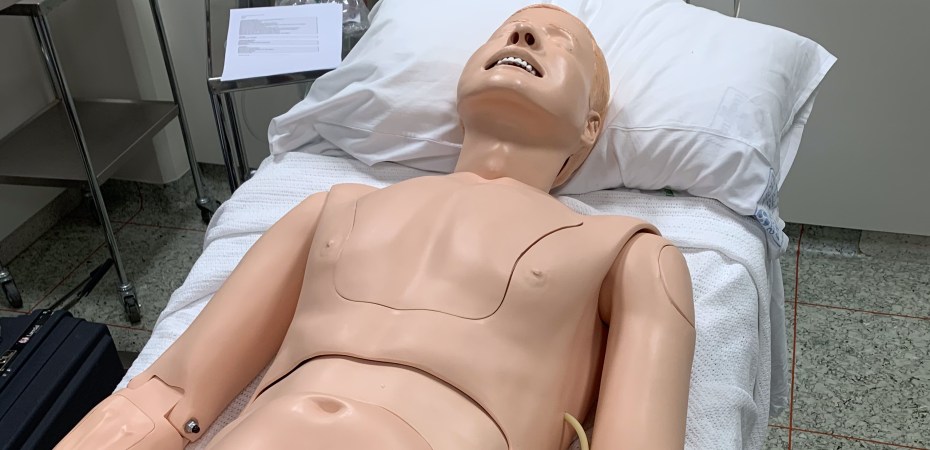
This is some reading for you to prepare before the introductory week and the simulations cases we will do during your orientation week. Everyone comes from different backgrounds and different places, we want to make sure that we cover the basics during these exercises.
We don’t expect you to know everything, the goal is to do standardize the knowledge and starting having reflexes when things go sour.
Trauma
After a few months, you will dream of primary surveys. After a while, it should be engrained into the deepest parts of your brain. The ABCDE examination is a major part of emergency medicine and when things go to hell, we usually fold back to it or some version of it. We will focus on the primary and secondary assessments, the major concepts of trauma management, the equipment and where to find it.
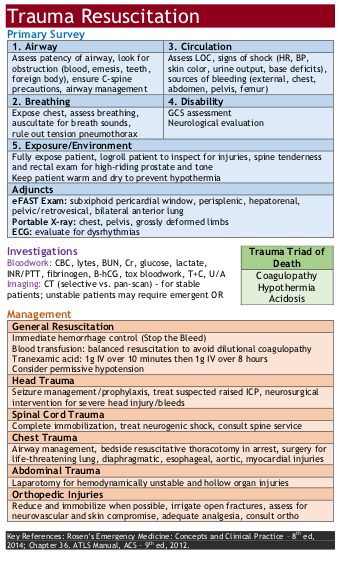
Source : Ottawa’s Clerkship Guide to Emergency Medicine, 2020
Additional reading on Primary and Secondary exam.
Basic airway and sedation
Please review the institutional procedural sedation checklist. Be familiar with its content : patient identification, fasting rules, equipment and monitoring of the patient. ER physicians do procedural sedations quite frequently in the department and it is important everyone gets familiar with the checklist.
We have to fill it for EVERY sedation then we need to put it in the small white box where the computers are on the A-side.
When doing a sedation, the most common complications are hypoxemia, bradypnea and respiratory arrest. In these cases, proper management of the airway is crucial. There are many techniques and items that you need to get familiar with and here is an excellent blog post from First 10 EM on Basic Airway. Please read it and watch the movies beforehand.
We are also moving in favor of using capnography during sedation and you need to get familiar with the concept.
Toxicology
We could talk about toxicology forever. People do fellows and dedicate their life to it. We will cover the basics on management of various toxicology presentation making sure that the major concepts are well mastered : safety of the patient and the staff, ABCDE, antidotes, resuscitation, etc.
LITFL have a great webpage on the Approach of the intoxicated patient.
Cardiac arrest
We will not review the full ALS, but we want to make sure the basics of cardiac resuscitation are well covered. We won’t talk about fancy stuff like ECMO, arterial lines or TEE. Not yet.
What saves lives is good quality CPR, early identification of a shockable rhythm and its shock, and good team communications.
This is what we will talk about. Before hand, review what defines good quality CPR, review the cardiac arrest algorithm and we will go together over our defibrillator.
Communication
This year, one point we are insisting on is efficient communication during resuscitation.
Be familiar with the Zero Point Survey, closed-loop communication, sharing your mental model and the concept of being a leader.
Here is a document on communication to help you.
Looking forward to do this with you!
Make ER Great Again. MEGA.
 Frozen Doc