
The best and worst thing that happened to our ED was the closure of Hjartagátt (literally the “entrance of the heart”, our cardiac institute). It increased our workload but it made us seeing cardiac cases again.
In the North Atlantic area, one thing we can notice easily is that the cardiologists are agressive with rhythm control for atrial fibrillation. More precisely electrical cardioversion. I have to say that I like that approach, it is fast and extremely efficient. No waiting on the procainamide drip, you zap and it is 100% all renewable electricity. I like it. But for this, procedural sedation is required. The multiplication of sedations we did in the ER gave us a great exposure. Exactly what we needed.
Initially, we had to protect this technique in our department, which we did well. We have yet to compiled the numbers but I would say we did about one sedation per day (cardiac and non-cardiac). I have not compiled my personal numbers yet, but I would say that I have done at least 50 sedations (and possibly much more) which in retrospect, seems like a huge number to me.
With Hjalti, we developped the Slæving á bráðadeild – Gátlisti (just a beautiful way to say Checklist for Procedural Sedation in the ER). One day we will look at the numbers, make sure we monitor the quality of our care, but as of now, I have not heard of any severe adverse event.
The most common adverse events is hypoventilation followed by hypoxemia (for a nice review on its management, here). The key is to detect it early and act on it with basic maneuvers. I still have to find another word for Basic airway management, because “Basic” refers to something that is for the beginner, for the non-expert. But to me, it is one of the most important skill to have, and some people still struggle with it. So we should change for another term, TBD.
All in all, here is what I learned from this big year :
- We have proven that ER physicians can do the sedations safely. I have not heard of any single cases that resulted in serious adverse events in our ER. We have a group of competent specialists and residents in our department and it something that we have earned proudly. Good job everyone!
- The use of a checklist standardizes our care and ensure all the equipment is ready in case of. Patient vomits, suction was ready. Patient stops breathing, we are in position and we just do a few maneuvers to manage it. Desaturation after long apnea : BVM was ready. Checklist ensures that nothing is forgot and we are ready to act quickly. This is a high risk procedure and we need to be ready.
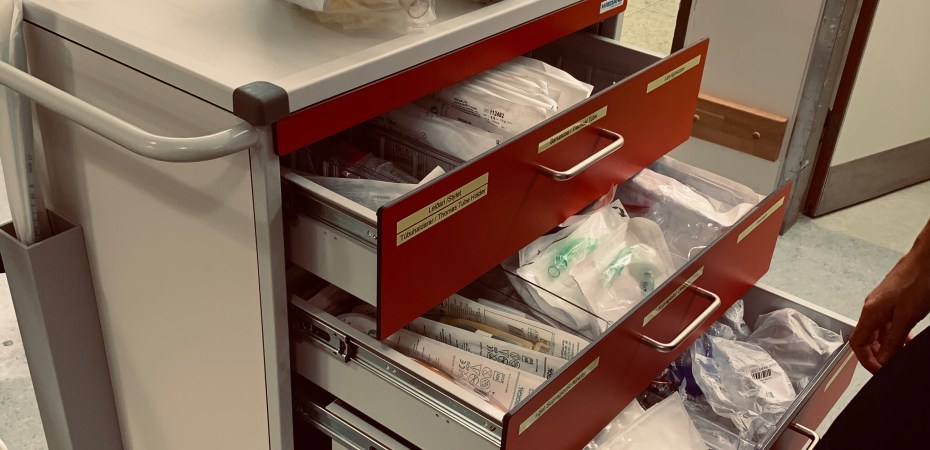
- I had one case where the patient became apneic and desaturated to 85% and it was a sedation in the radiology department, using two different medications in an intoxicated patient and all the equipment was brought except a bag valve mask. It was a huge mistake. A beginner’s mistake. I thought we had it but we didn’t, in the panic, nobody found it in the anesthesiology cart. To see the patient desaturating slowly despite airway opening and oxygen at full flow was one of the scariest thing that happened to me. We sent someone running to the ER, brought back the BVM, bagged the patient and the saturation came up nicely. No adverse event but I felt extremely powerless. In hindsight, the mistakes were: combination of different sedative agents in an intoxicated patient, a sedation outside the department (not in my ‘hood) and the biggest was the lack of the bag valve mask. Never again.
- I am a big fan of the double set-up with capnography and a non-rebreather mask (NRB) at 15L/m. This ensures that the patient is well preoxygenated with the NRB and that we detect hypoventilation early with the capnography. In the studies, oxygen supplementation can blunt the capnography reading, but from my experience, I feel the frequency and height of the curve on graph is really helpful.
- The depth of sedation is something to be clarified. Deep sedation is defined as “Purposeful response following repeated or painful stimulation and airway intervention may be required“. This is what we do most of the time. If you want the patient NOT TO MOVE AT ALL despite painful stimuli, you are in the General Anesthesia realm. This is defined as “Unarousable, even with painful stimulus and airway intervention often required“. That means, grand-mother dislocated her hip, you can see her breathing slowing down after receiving propofol but when you pull on it strongly she moves a little but you can reduce he hip. To me it is ok. We are doing a deep sedation. If she resists too much, give a little more. But if you dont want her to move at all, you need to go to the OR. And it is ok, rarely the procedure fails and we have to send them to the theater for complete relaxation. But to completely knock patients out in the ER, that they do not feel anything and their breathing is suppressed, it qualifies as a General Anesthesia. Call anesthesiology and go to the OR, they are great people. The line is thin between those two categories and you want to put them in the area where they still breath but don’t move despite painful stimuli. I do not encourage under treatment, I just encourage the patient to be in the right state at the right place.
With all the experience we have gained in the last year, and with the fact that we have proven we can do it safely in the ER, we have own and we deserve it.
Congratulations everyone.
Do not forget to Make ER Great Again. MEGA.
 Frozen Doc