
(sorry for the long delay, this post should have been published a month earlier…)
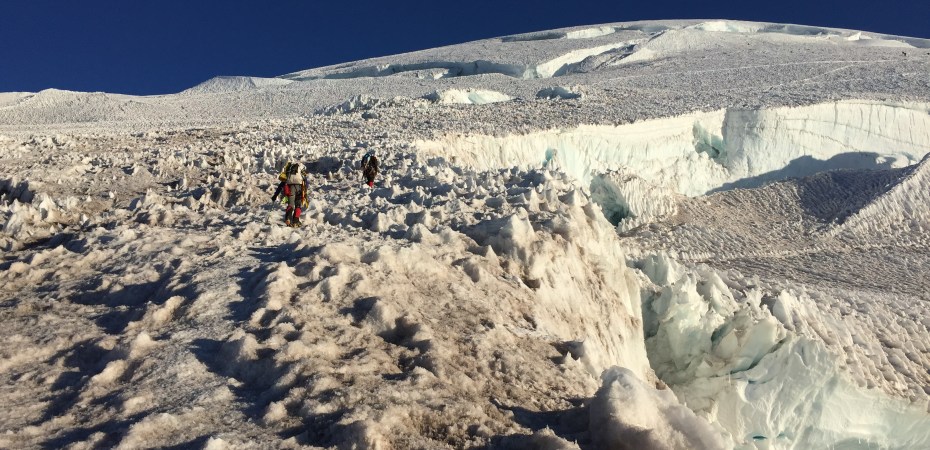
Mount Rainier was a great mountaineering experience. The trail was in good shape but the warm conditions putted us on alert during our descent. We could see the glaciers melting and the crevasses were widely opened.
Going back to the ultrasound experiment. Unfortunately, it was an inconclusive experiment.
We didn’t have the chance to scan our lungs at the summit for different reasons. But we did scan it at Camp Muir(3100m) before and after our summit.
The protocol used was at bilateral anterior 3rd-4th intercostal space and bilateral posterior basis with a curvilinear probe (V-scan GE) on my friend and I.
At sea levels, we both had normal A-lines on the four views.
At Camp Muir, the first day, our scans were still negative.
The day of the summit, back to Muir, we rescanned our lungs and it remained unchanged.
I wasn’t surprised with theses results.
First, Muir is at relatively low altitude. Also, the summit of Mount Rainier is not particularly high and this climb is not known for altitude-sickness. Maybe if we had the opportunity to scan our lungs at the summit it would have been different.
That brings a question : how quickly do comet tails appears? We were well acclimatized at Muir, we summited then came back to Muir. Our progression in altitude was short-lived (one day back and forth to summit then sleep at same altitude). Maybe the process in the lungs takes a few hours before developing comet tails.
Our personal case reports contrast with a study looking for comet tails at 3440m. Although they were higher, the vast majority (15/18 participants) had lung comets. They might have spent more days than us at high altitude and maybe the lungs started showing changes. Additionally, they looked at 28 scanning sites. We only looked at four.
The reason I decided to look at only four sites is that we need a more pragmatic approach to scanning the lungs. 28 sites is a lot. On the field, we should use US as a yes or no answer. I don’t think we should get into fine tunings and measuring the absolute count of B-lines. Still, we need an approach for scanning the lungs at high altitude that will be the perfect compromise between the number of sites scanned (time and gel consuming in the backcountry, time exposed in the elements) and the highest sensitivity/specificity for comet tails.
Bottom line
-No evidence of comet tails at 3100m after one night at this altitude.
-Also, no evidence of comet tails after a same day progression from 3100m—> 4395m—> 3100m.
-n=2
References :
Pratali, L., Cavana, M., Sicari, R., & Picano, E. (2010). Frequent subclinical high-altitude pulmonary edema detected by chest sonography as ultrasound lung comets in recreational climbers. Crit Care Med, 38(9), 1818-1823.
 Frozen Doc